Calling all Jazz Girls and Flappers!
Mar. 10th, 2005 10:43 pm![[personal profile]](https://www.dreamwidth.org/img/silk/identity/user.png) changeling
changelingI'm sure some of you have a passing interest, probably a passing knowledge of the 20s era fashion. Can you recommend me any websites or pattern companies I might try? I need to put together an evening outfit by April 23rd.
Things to note:
I am a curvaceous girl. I have wide hips and a small waist. Some of the designs will look like bollocks on me. Also, I refuse to bare my upper arms if it can be at all avoided.
Things to be joyful of:
The general 20s–30s style currently in Myer. Maybe if I save I'll be able to get myself some appropriate shoes. WHEE!
INFORMATION
The Elusive Hemline of the 1920s.
Gradually by degrees they gave the illusion of being first long and then shorter with dipping, scalloped and handkerchief hemlines in floating fabrics. It was only in 1925 that skirts rose 14 to 16 inches (45 to 50 cm) from the ground making the shorter hemline we associate with the era.
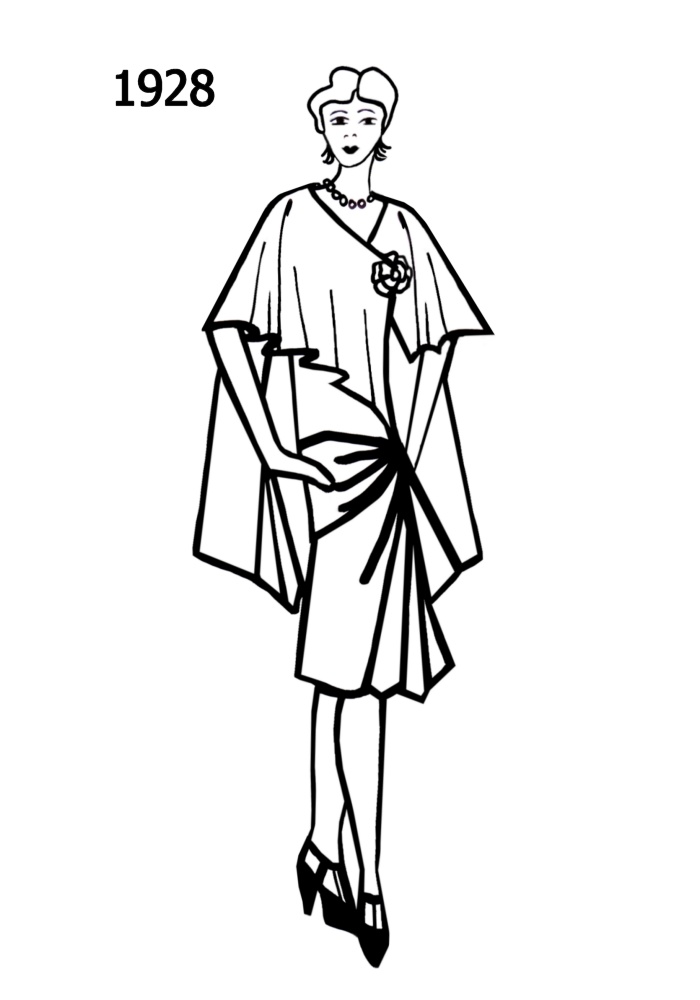
By 1926 skirts were at their shortest in the Twenties decade and showed the knee until 1928. The whole leg as far as the kneecap was revealed.
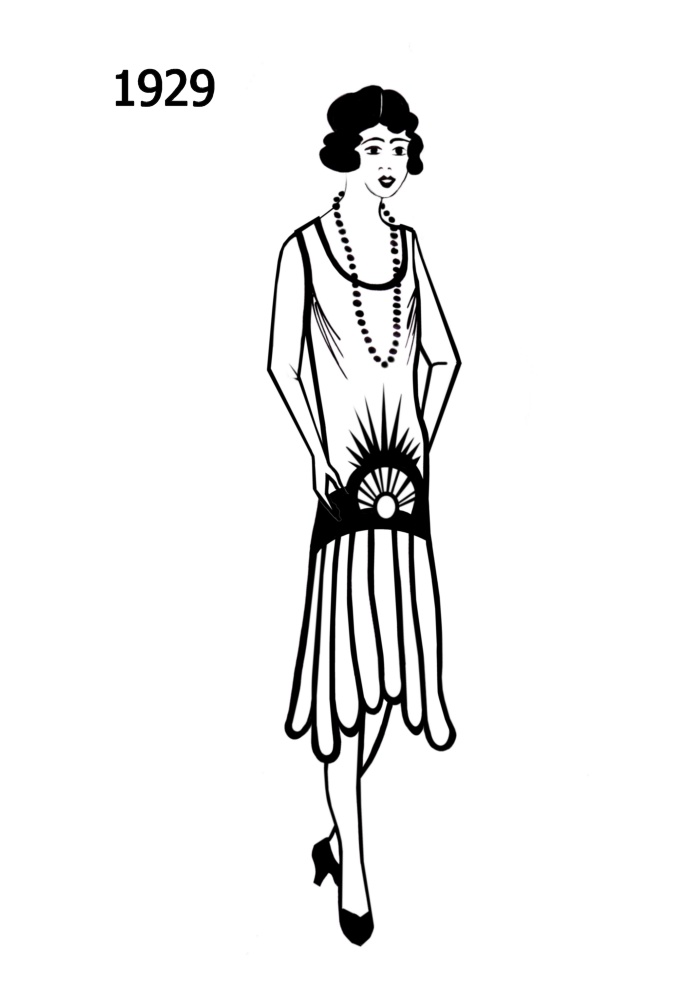
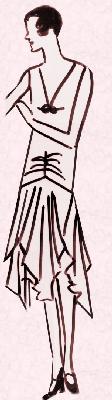
By 1929 uneven hems and asymmetric skirt hemlines again helped the transition to longer skirts. Longer sheer overskirts and semi sheer top skirts were worn over shorter linings. By 1930 the hemline was several inches below the knee.
Flappers did not truly emerge until 1926
Shortness is a popular misconception reinforced by the availability of moving film of the Charleston dance which shows very visible knees and legs on the dancing flappers.
Skirts only revealed the knee briefly between 1926 and 1928, and this was the only period when evening dresses were short in line with day dress lengths. This was the flapper period.
The arms were bared not only for evening, but also for day and the legs were covered in beige stockings visible to the knee which gave an overall more naked look than ever before. Feet, ankles and calves formerly hidden and encased in black stocking were suddenly on show.
Between 1920 and 1928 corset sales declined by two thirds, but it adapted to changing needs. Fast flappers refused to wear corsets and rolled their stockings to the knee to enable them to dance easily. Long Corsets produced the boyish figure, but instead of thick boned corsets many women preferred thin elastic webbing Lastex girdles that flattened the abdomen. Suspenders were attached to the girdles. Underwear was minimal, sheer and lightweight. Women wore cami-bockers (directoire knickers and chemise) or cami-knickers or knickers and a petticoat.
T bar shoes with buckles and bows and straps featured in the 1920s.
The Mary Jane ankle strap button shoe was the style of the twenties.
Footwear was visible beneath short dresses and was selected with more care as a fashion accessory.
Once shoes began to be mass manufactured in the 1920s footwear became an essential fashion accessory. Now it was truly visible beneath shorter dresses it needed to be selected with more care. Heels were over 2 inches high and waisted until the 1930s when they were lower straighter Cuban shapes. Strapped shoes were called Mary Janes. T bar shoes or others with buckles and bows made interesting fashion statements. Sequin or diamante trims were quite usual.
In the 1930s shoes began to look heavier, but the toes were less pointed and more rounded, often of peep style. In 1936 Ferragamo the Italian shoe designer made wedge heel designs and by the 1940s, chunkier wedged platform shoes with thicker soles made the wearers feel they could walk for miles if needed.
Images of the different years:
1920–1921
1922–1923
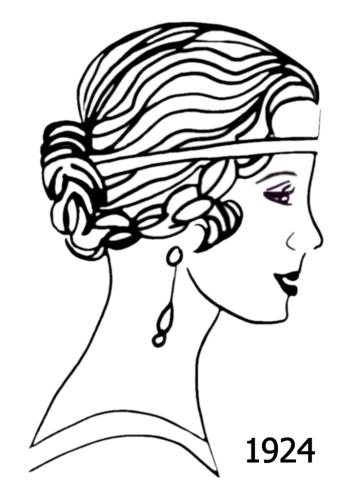
1924–1925
1926–1927
1928–1929
Examples of shoes
Images and patterns of dresses
Another image
The hairstyle I like
One of the dresses I'm interested in
Another dress
Another dress
Unrelated to the flapper evening, but I REALLY REALLY want this coat. I might try and find a pattern.
More images & links.
P.S.: If anyone suggests a sheath dress with fringing around the bottom, I will hit them.
Things to note:
I am a curvaceous girl. I have wide hips and a small waist. Some of the designs will look like bollocks on me. Also, I refuse to bare my upper arms if it can be at all avoided.
Things to be joyful of:
The general 20s–30s style currently in Myer. Maybe if I save I'll be able to get myself some appropriate shoes. WHEE!
INFORMATION
The Elusive Hemline of the 1920s.
Gradually by degrees they gave the illusion of being first long and then shorter with dipping, scalloped and handkerchief hemlines in floating fabrics. It was only in 1925 that skirts rose 14 to 16 inches (45 to 50 cm) from the ground making the shorter hemline we associate with the era.
By 1926 skirts were at their shortest in the Twenties decade and showed the knee until 1928. The whole leg as far as the kneecap was revealed.
By 1929 uneven hems and asymmetric skirt hemlines again helped the transition to longer skirts. Longer sheer overskirts and semi sheer top skirts were worn over shorter linings. By 1930 the hemline was several inches below the knee.
Flappers did not truly emerge until 1926
Shortness is a popular misconception reinforced by the availability of moving film of the Charleston dance which shows very visible knees and legs on the dancing flappers.
Skirts only revealed the knee briefly between 1926 and 1928, and this was the only period when evening dresses were short in line with day dress lengths. This was the flapper period.
The arms were bared not only for evening, but also for day and the legs were covered in beige stockings visible to the knee which gave an overall more naked look than ever before. Feet, ankles and calves formerly hidden and encased in black stocking were suddenly on show.
Between 1920 and 1928 corset sales declined by two thirds, but it adapted to changing needs. Fast flappers refused to wear corsets and rolled their stockings to the knee to enable them to dance easily. Long Corsets produced the boyish figure, but instead of thick boned corsets many women preferred thin elastic webbing Lastex girdles that flattened the abdomen. Suspenders were attached to the girdles. Underwear was minimal, sheer and lightweight. Women wore cami-bockers (directoire knickers and chemise) or cami-knickers or knickers and a petticoat.
T bar shoes with buckles and bows and straps featured in the 1920s.
The Mary Jane ankle strap button shoe was the style of the twenties.
Footwear was visible beneath short dresses and was selected with more care as a fashion accessory.
Once shoes began to be mass manufactured in the 1920s footwear became an essential fashion accessory. Now it was truly visible beneath shorter dresses it needed to be selected with more care. Heels were over 2 inches high and waisted until the 1930s when they were lower straighter Cuban shapes. Strapped shoes were called Mary Janes. T bar shoes or others with buckles and bows made interesting fashion statements. Sequin or diamante trims were quite usual.
In the 1930s shoes began to look heavier, but the toes were less pointed and more rounded, often of peep style. In 1936 Ferragamo the Italian shoe designer made wedge heel designs and by the 1940s, chunkier wedged platform shoes with thicker soles made the wearers feel they could walk for miles if needed.
Images of the different years:
1920–1921
1922–1923
1924–1925
1926–1927
1928–1929
Examples of shoes
Images and patterns of dresses
Another image
The hairstyle I like
One of the dresses I'm interested in
Another dress
Another dress
Unrelated to the flapper evening, but I REALLY REALLY want this coat. I might try and find a pattern.
More images & links.
P.S.: If anyone suggests a sheath dress with fringing around the bottom, I will hit them.